
N°26
Colliers, par Miquel Bassols
L’amour des livres
Platon woke?, par Violaine Clément
Où nous mène l’IA? – Opinions dans le New York Times


Lacan Quotidien propose une sélection d’extraits d’un article paru dans le New York Times, que nous invitons à lire sur le site du journal www.nytimes.com sous le titre «Where is I.A. taking us?» ici.
Où nous mène l’IA?
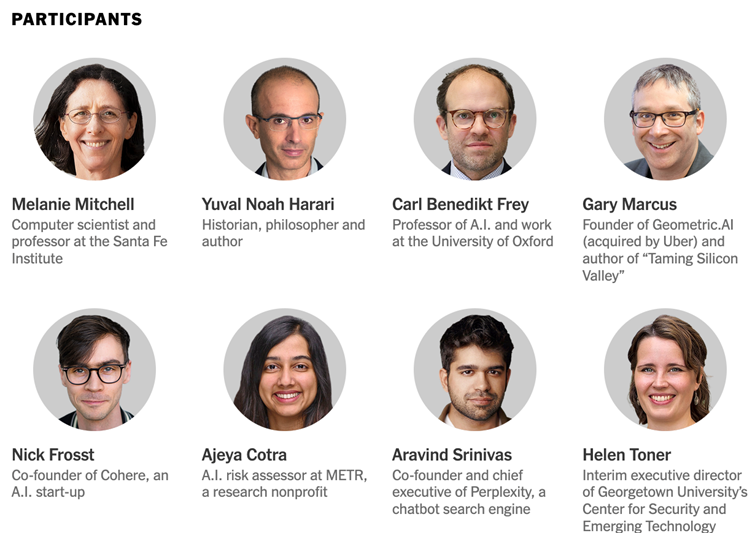
Huit grands penseurs partagent leurs visions
The New York Times – OPINION
« Aujourd’hui, nous sommes submergés de discussions sur la façon dont l’intelligence artificielle va transformer nos vies et notre monde. […] Alors que la société se demande si l’intelligence artificielle nous mènera vers un avenir meilleur ou catastrophique, Times Opinion a demandé à huit experts de donner leurs prévisions sur l’évolution de l’intelligence artificielle au cours des cinq prochaines années. Les écouter pourrait nous aider à tirer le meilleur parti de cette nouvelle technologie et à en atténuer les inconvénients. » — The New York Times – OPINION
« Now, we are inundated with chatter about how much A.I. will transform our lives and our world. […] As society wrestles with whether A.I. will lead us into a better future or catastrophic one, Times Opinion turned to eight experts for their predictions on where A.I. may go in the next five years. Listening to them may help us bring out the best and mitigate the worst out of this new technology. »
What will A.I.’s impact be on medicine in the near term?
Gary Marcus Cognitive scientist
We’ve seen lots of proof of concept, but there hasn’t been much real-world application yet to my knowledge beyond medical note taking.
Nick Frosst Co-founder of Cohere
A.I. will absolutely increase the effectiveness of doctors by reducing their workload per patient in areas like the ability to quickly review their medical histories, effectively organize new medical information and identify potential problems earlier.
But while A.I. is extremely good at analyzing huge amounts of data and finding answers and useful patterns, it is really bad at coming up with entirely new ideas. The idea that A.I. is likely to autonomously create new medicines, for example? People will probably be disappointed.
What will A.I.’s impact be on scientific research?
Melanie Mitchell Computer scientist
I believe this impact will not be as rapid as many think. A.I. systems still can’t do things humans are essential for, like asking the right questions, planning experiments and entire scientific programs, and understanding data in different contexts.
Aravind Srinivas Chief executive of Perplexity
As A.I. increasingly contains more of the world’s knowledge, it becomes an even more powerful tool for anyone with questions. Humans have always been great at having questions. A.I. will be great at having answers.
What will A.I.’s impact be on mental health?
Melanie Mitchell Computer scientist
On the bad side: A.I.-induced psychosis! On the good side, some people will get a lot out of using chatbots as therapists.
Yuval Noah Harari Historian
The rapid changes of the A.I. revolution are likely to cause a mental health crisis as humans struggle to adapt. We are about to conduct the biggest psychological experiment in human history, on billions of human guinea pigs, and nobody can predict what the results will be.
Nick Frosst Co-founder of Cohere
A.I. chatbots offer scalable support for mild symptoms but they’re no substitute for human therapists. The technology struggles with nuance, cultural context and long-term emotional depth. There are many mental health care challenges that should be handled by human professionals.
What’s one misconception about A.I. that you think is worth dispelling?
Melanie Mitchell Computer scientist
The misconception that A.I. has “magic” or “emergent” abilities that are impossible to understand and predict. This is mainly a view of the public (and policymakers, to some extent). Technologists and Silicon Valley often push this narrative but I don’t know how much they really believe it.
Yuval Noah Harari Historian
A.I. isn’t a tool entirely under human control — it is an agent that can make decisions and invent ideas by itself. While I don’t think A.I. will become conscious in the near future, it is highly likely these models will be able to simulate consciousness very effectively, causing a significant percentage of humanity to believe they are conscious.
Carl Benedikt Frey Economist
It’s a mistake to assume A.I. will leave manual work untouched. In practice, A.I. systems are lowering knowledge barriers and enabling competent do-it-yourself repairs. A homeowner can photograph a worn washer or boiler, receive a parts list, and follow a clear, step-by-step guide to replace it.
Gary Marcus Cognitive scientist
People are greatly confused about large language models, attributing a humanlike intelligence to mimicry machines that turn out to be superficial and unreliable. Intelligence is about reasoning flexibly in face of the unknown, and large language models continue to struggle mightily with that.
Nick Frosst Co-founder of Cohere
It’s a misconception that A.I. is autonomous. Today’s systems are sophisticated pattern-matchers, not thinkers.
Ajeya Cotra A.I. risk researcher
Whenever the latest generation of A.I. fails to make an enormous impact immediately, A.I. skeptics wrongly assume that this disproves the concerns about A.I.’s catastrophic risks.
Aravind Srinivas Chief executive of Perplexity
It’s a misconception that A.I. will result in vast unemployment. New technologies sometimes shift the nature of work in society, but they don’t remove working from society.
Helen Toner A.I. policy researcher
I believe the narrative around A.I.’s negative environmental impacts has gotten way out of hand. Yes, on aggregate the industry uses quite a bit of energy and water, but that’s true of any large industry. The relevant question is how it compares to other industries, and how it compares to how much value we’re getting out of it.
Nick Frosst Co-founder of Cohere
A.G.I. requires abstraction, self-awareness and transfer learning across domains — all capabilities that are nowhere near. The architecture of the human brain is still a black box, and computing paradigms aren’t designed for it. Possible in 50 years? Maybe. In 10? Unlikely.
Aravind Srinivas Chief executive of Perplexity
A.G.I. is still poorly defined. So we don’t think about it much.